

Augura Space est une start-up deeptech issue de travaux de recherche menés...
Read more
The Sun-Earth Thematic Action (ATST)
The Sun-Earth Thematic Action (ATST¹) is a component of the National Astrophysics Program (PN Astro) under the CNRS Earth and Universe Institute (INSU). The ATST aims to fund research projects and foster the national scientific community’s engagement with heliospheric plasma physics. The main themes of the ATST include:
- The Magnetic Sun – its interior and atmosphere – its activity and eruptions;
- The Solar Wind – from the Sun to the interplanetary medium – its origin, acceleration, and disturbances;
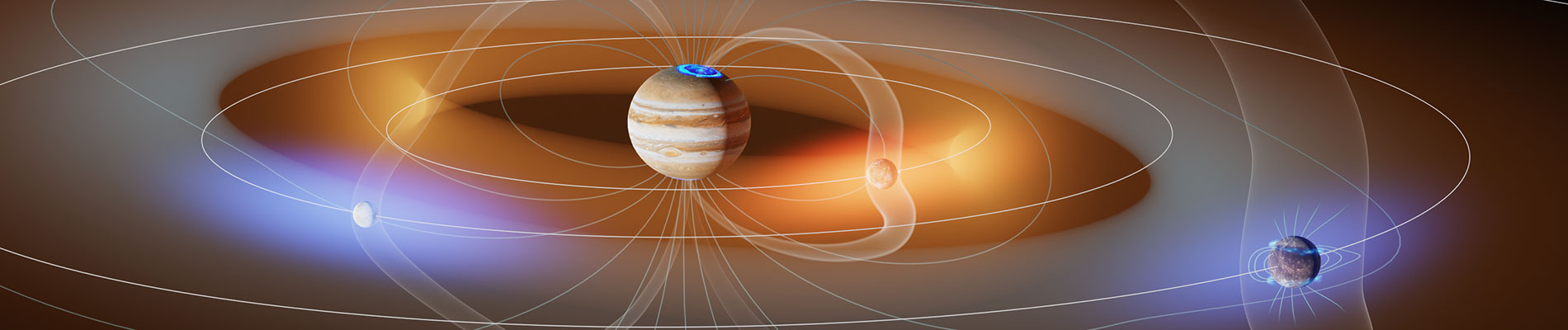
- Magnetospheres and Ionospheres – of Earth, the solar system’s planets, and exoplanets – their responses to solar forcing and impulsive events;
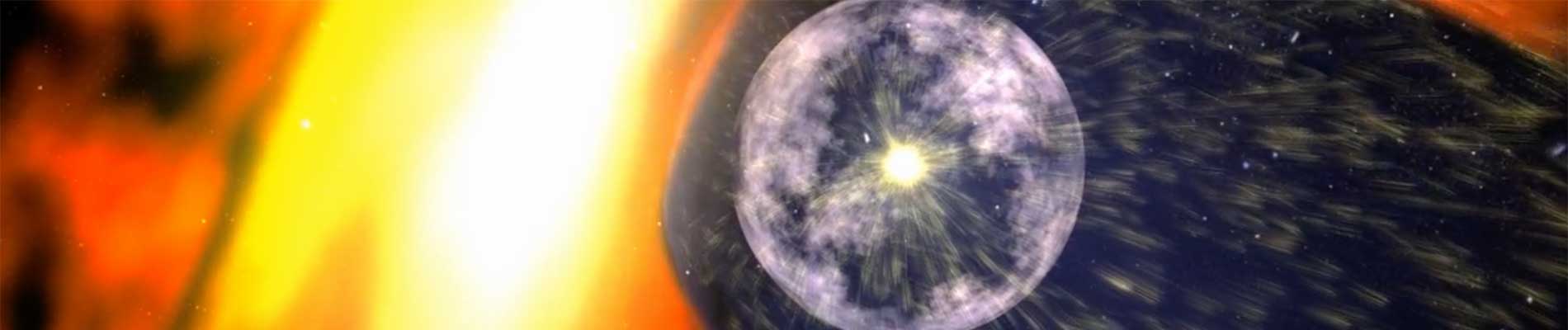
- The Heliosphere – as a whole, including its interaction with the interstellar medium – the mechanisms shaping its structure;
- Space Weather – forecasting solar geoeffective disturbances, monitoring the Sun, the near-space environment, and their impacts on the various envelopes of the Earth and other planets.
A unique aspect of the ATST community is its focus on studying the fundamental physical processes occurring under a wide variety of physical conditions, as found in heliospheric plasmas. Specifically, it seeks to understand:
- How the solar dynamo operates and the flux emergence process works;
- How instabilities are triggered and how large-scale feedbacks occur in both fluid and collisionless regimes;
- What are the effects of atomic physics on ionization, radiative transfer, and light polarization;
- What mechanisms accelerate plasmas and energetic particles, and dissipate energy via shocks, magnetic reconnection, waves, and turbulence;
- How to translate fundamental research results into applied tools for space weather forecasting.
Footnote: ¹ The ATST originates from the former National Sun-Earth Program (PNST).
Upcoming events
15
Sep
3rd SciQLop Workshop
15 September 2026 - 17 September 2026
Toute la journée
We are pleased to announce the 3rd edition of the SciQLop Workshop, to be held on September 15–17, 2026 at the Jussieu campus, Paris. This [...]
18
Sep
PhD Defense of Francisco Javier Polanco Rodríguez
18 September 2026
14h00 - 17h00
I am very happy to invite you to the defense of my PhD thesis, entitled: “Electromagnetic Emissions at the Plasma Frequency by Type III Solar [...]
21
Sep
ESLAB and 3rd Heliophysics in Europe meeting
ESLAB is an regular Symposium organised by the Science and Operations Department in the European Space Agency's Directorate of Science. The ESLAB Symposia have been [...]
28
Sep
Journées scientifiques d'hommage à Monique Pick
28 September 2026 - 29 September 2026
Toute la journée
Nous organisons les 28 et 29 Septembre deux journées de conférences à l'observatoire de Meudon (centre Jules Janssen) pour rendre hommage à la carrière et [...]
05
Oct
2026 DASH/IHDEA Meeting
The 2026 DASH / IHDEA Meeting will take place 5-9 October 2026, at the Royal Irish Academy of Music in Dublin, Ireland, hosted by the [...]
20
Oct
4D Ionosphere 2026 Workshop
4D Ionosphere 2026 Workshop will take place at ESA-ESRIN, Frascati (Italy) from 20 to 22 October 2026. We kindly invite you to submit your abstract, [...]
Our latest ads
Solar Orbiter science nuggets (Summer 2026 releases)
It is our pleasure to share new Solar Orbiter science nuggets (Summer...
Read moreOpportunité de collaboration franco-chinoise autour de la plateforme expérimentale SPERF
La National Natural Science Foundation of China (NSFC) lance en 2026, à...
Read morePhD opportunity – Energy Transfer in Turbulent Space Plasmas (École Centrale de
This PhD project is part of a French-Japanese collaboration between the CNRS...
Read moreESA Archival Research Visitor Programme
To increase the scientific return from its space science missions, ESA welcomes...
Read moreESA Research Fellowships in Space Science
Applications are now open for the 2026 ESA Research Fellowships in Space...
Read moreAugura Space recrute un(e) Head of Science – Météo spatiale et environnement spatial
Augura Space est une start-up deeptech issue de travaux de...
Read moreSolar Orbiter science nuggets (Summer 2026 releases)
It is our pleasure to share new Solar Orbiter science...
Read moreOpportunité de collaboration franco-chinoise autour de la plateforme expérimentale SPERF
La National Natural Science Foundation of China (NSFC) lance en...
Read morePhD opportunity – Energy Transfer in Turbulent Space Plasmas (École Centrale de Lyon – Laboratoire de Mécanique des Fluides et d’Acoustique)
This PhD project is part of a French-Japanese collaboration between...
Read moreESA Archival Research Visitor Programme
To increase the scientific return from its space science missions,...
Read moreESA Research Fellowships in Space Science
Applications are now open for the 2026 ESA Research Fellowships...
Read more